

Who’s Searching for What – and Why?

When we built Leo, our AI search worker for hotels, we knew he had to understand the complexity and nuances of hospitality. The priority was clear: start with the property and build up to the brand.
by Chris Archer-Brown 3 minute read
When we built Leo, our AI search worker for hotels, we knew he had to understand the complexity and nuances of hospitality. The priority was clear: start with the property and build up to the brand.
Unlike Netflix or Coca‑Cola, hotels can’t deliver a perfectly uniform global experience. A guest’s stay is shaped by what is in and around a specific property – the street, the neighbourhood, the local partners – so even the best‑run brands will see real differences between Lisbon and New York.
That said, you can’t ignore the bigger picture. The aggregate view across a portfolio matters. And so does the searcher: where they are, who they are, and what they are trying to do.
This is exactly what Leo is designed to recognise. Which is why we’re introducing two new capabilities: Multi‑Property Accounts and Scenarios.
Brand vs Property: Who Are They Really Searching For?
In 2026, one deceptively simple question sits at the centre of AI search performance for hotels: are they searching the brand, or the property?
In a world of AI Overviews, trip‑planning agents and conversational assistants, that distinction matters more than ever. A guest asking “best hotels near Central Park” sends a very different signal from someone searching specifically for “The Plaza Hotel” – yet both journeys may begin, and end, inside an AI‑generated answer rather than on your website.
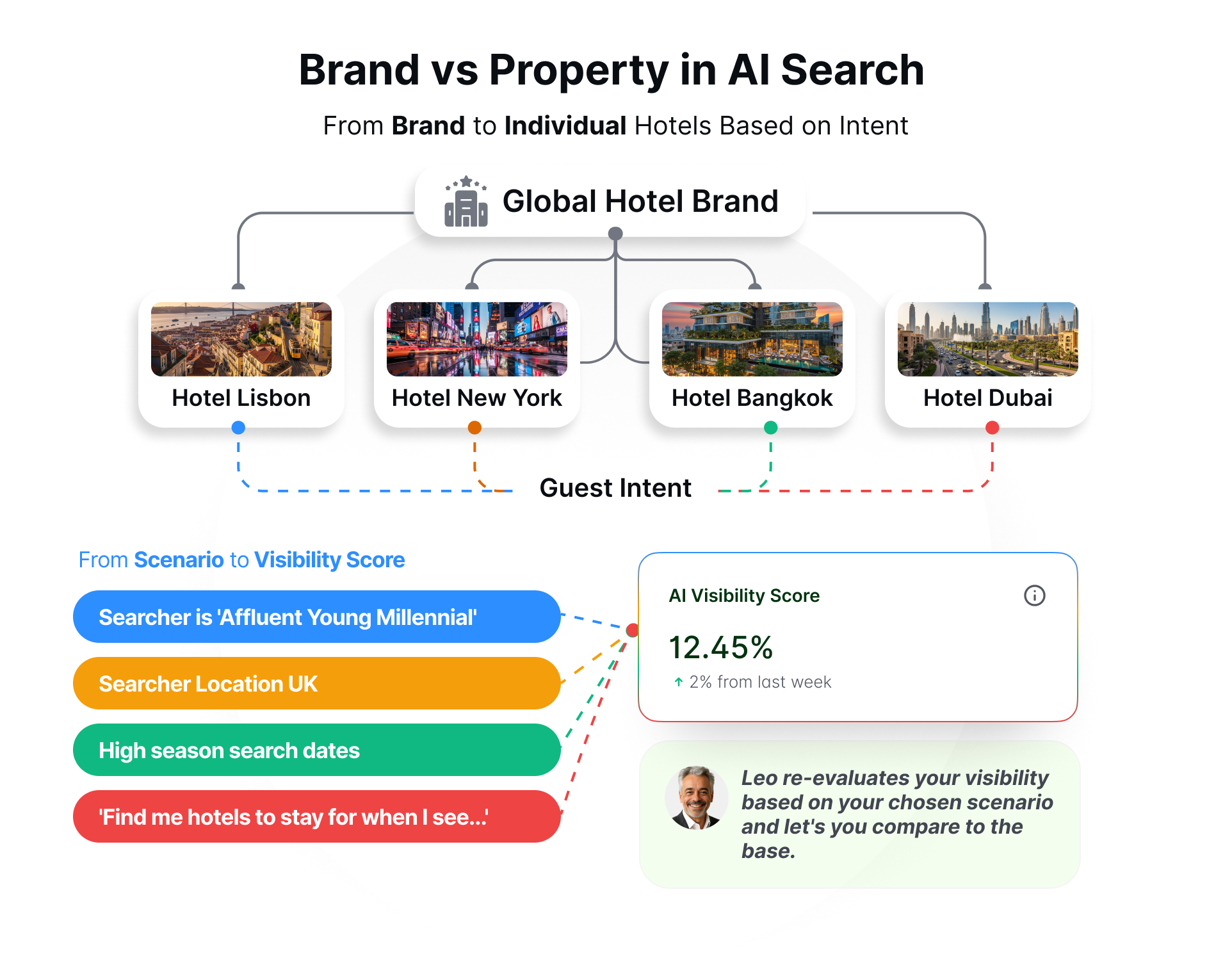
Most hotel teams still measure visibility using traditional SEO and brand search volume. AI systems do not think that way. They reason across entities – brands, individual properties, neighbourhoods, even restaurant and bar concepts – and then decide which unit to recommend for a particular intent.
If you only look at performance through a brand lens, you risk missing the properties that matter most. One flagship can appear everywhere, while a strategically important hotel is effectively invisible in AI‑driven search.
Introducing Scenarios: Testing AI Search Performance Safely
To help solve this, Leo now allows you to create Scenarios that let you experiment without affecting your core visibility score. You can run focused tests, learn quickly, and keep your main benchmark clean.
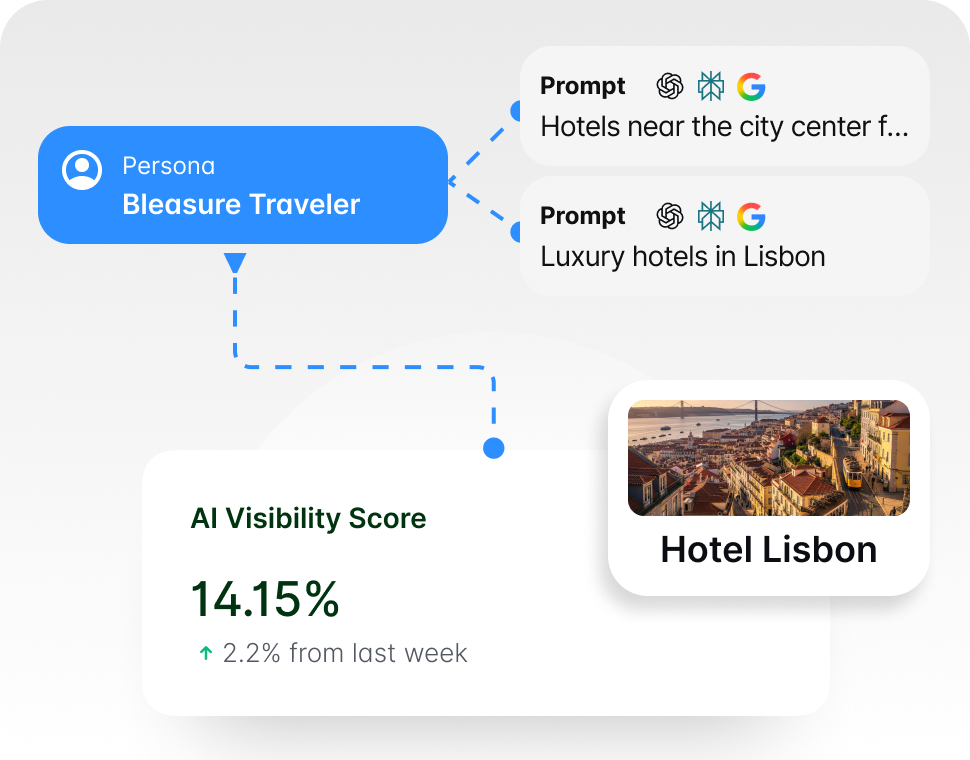
1. Compare Performance Across Personas
Scenarios let you compare AI search visibility across different personas: for example, a US‑based bleisure traveller vs a European family planning a city break. You see whether each group is being shown your property when they ask AI assistants for hotels in your destination.
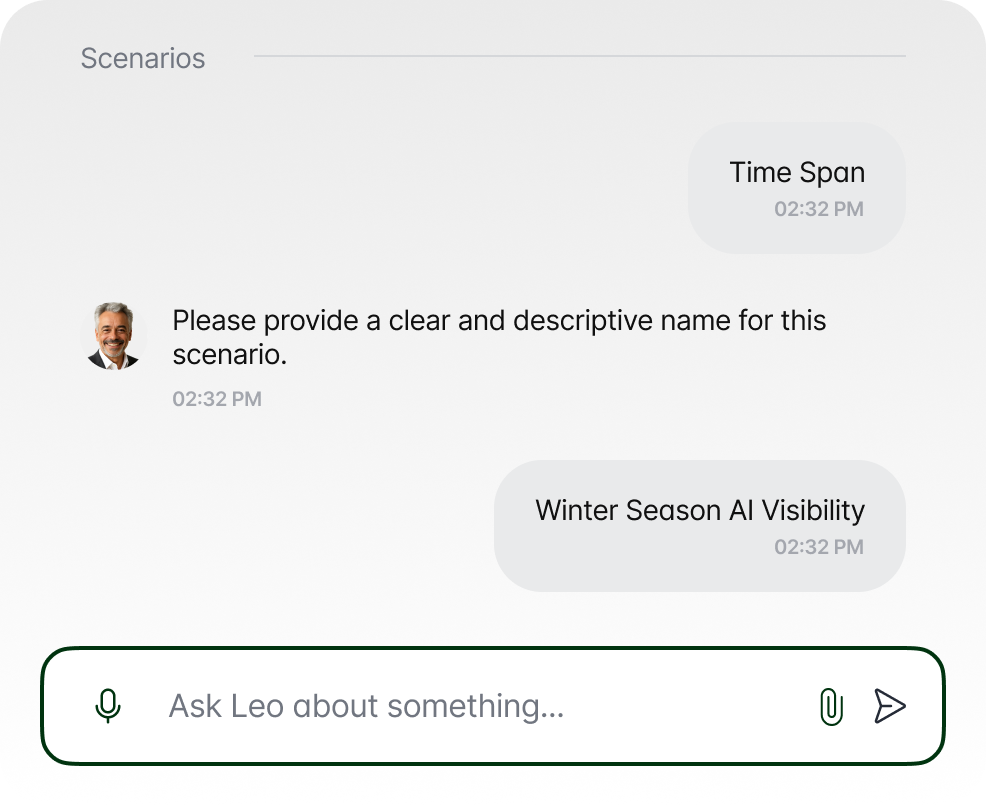
2. Understand Seasonality in AI Search
With Scenarios, you can add a time element and see how visibility changes when a searcher specifies “this summer,” “in December,” or “for a long weekend in May.” This helps you understand whether you are still recommended when it really counts for your revenue calendar.
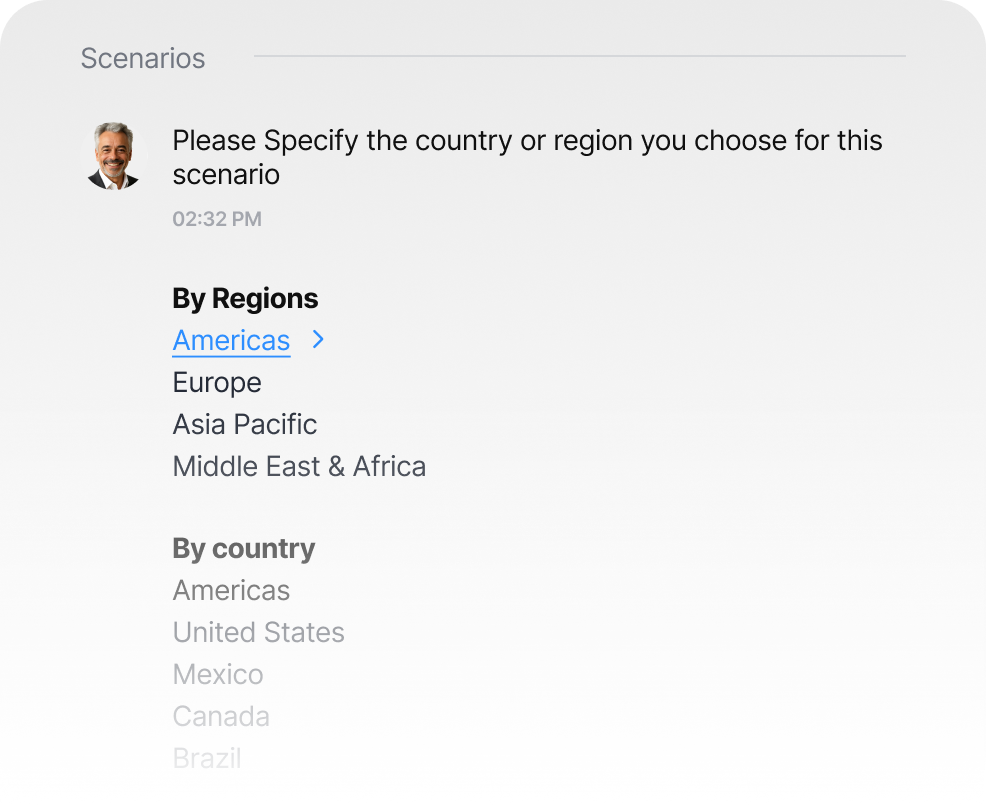
3. See Yourself Through the Searcher’s Home Market
4. Free‑Form Scenarios for Events and Niches
Beyond these structured scenarios, you can run free‑form evaluations.
For example, you can check whether your property is even in the conversation for a major upcoming event in your city. If the answer is “no,” it’s far better to learn that before delegates and visitors have already booked somewhere else.
Why This Matters for AI Search in 2026
AI search is increasingly where guests discover, shortlist and justify their hotel choices. Being “good” on traditional SEO is no longer enough.
By looking at both brand‑level visibility and property‑level performance – and by testing personas, seasons, geographies and events with Scenarios – you can see how AI systems really talk about you, and where you need to intervene.